CFP AAG 2027 // Critical Geographies of the Infrastructure Corridor

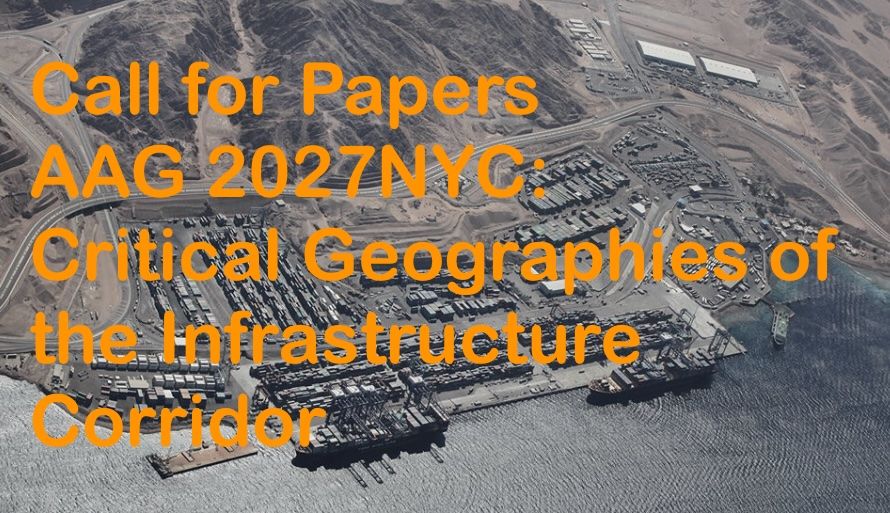
CFP AAG2027 NYC:
Critical Geographies of the Infrastructure Corridor
Organisers: Jonathan Silver, Urban Institute, University of Sheffield, Alan Wiig, Department of Geography, University of Florida
Infrastructure corridors promise a future of connectivity, circulation and investment and have become a dominant technology across a range of spaces, places and territories. They reflect a global shift in governance, capital flows, spatial planning approaches, logistical regimes and urbanisation processes. From massive programs such as the Belt and Road Initiative to regional integration projects such as the CAREC program in central Asia, or TEN-T network in Europe, through to bilateral projects such as the Addis Ababa–Djibouti corridor in east Africa, a new geography is emerging.
This session responds to these transformations to examine how global infrastructures are reshaping extended territories and operational landscapes, cities and hinterlands at speed and scale. Connected investments in real estate enclaves, railways, highways, ports, digital networks and data centres, manufacturing zones and pipelines generate new spatial arrangements, power relations and associated politics, and emergent as well as intensified injustices that demand new conceptual and methodological approaches.
In this session we aim to develop dialogue across critical scholarship on the infrastructure corridor. We welcome contributions across various kinds of geographic focus, debate and context to explore issues including:
- The political economy of corridorisation: The economic geographies of state capitalism, financialisation, multi-lateral lending, bonds and investments that are shaping new corridor geographies.
- The geo-politics of corridors: The ways in which corridors have become key sites of geo-political positioning through rearrangements of global, trans-continental, and regional power.
- Corridor Urbanisation: The new patterns of urbanisation being established through investments in infrastructures across extended, operational landscapes.
- Corridor Urbanisms: The everyday geographies of corridors and the lived experiences of urban inhabitation through which communities navigate, resist, or adapt to these projects.
- Against and beyond the corridor: Focusing on contestation and resistance to corridor initiatives and related infrastructure projects, as well as reimagining corridors through various forms of alternative imaginaries.
- Corridor megaprojects: How particular investments from data centres to ports to railways operate within the logic of broader corridor initiatives and with what implications.
- Methodologies for researching corridors: How to go about investigating corridors, from the use of big data through to everyday ethnographies, and the challenges and opportunities that this research presents.
If you are interested in participating, please submit an abstract of no more than 250 words along with your name, institutional affiliation, and contact information to j.silver@sheffield.ac.uk and alanwiig@ufl.edu by the 14th October 2026